
Harvest -ฤดูเก็บเกี่ยว

ร่วมแรงช่วยกัน ชาวนาในชนบทแถวภาคอีสานยังมีให้เห็นอยู่มากที่ไปขอแรงช่วยเกี่ยวข้าว หรือลงแขก แต่ยุคนี้ต่างจากแต่ก่อน ขอแรงแต่ก็จ่ายเงินด้วยประมาณ120-150บาท เจ้าของนาต้องเลี้ยงอาหารเที่ยงและมีเหล้าเบียร์น้ำหวานบริการอีกต่างหาก


ถ้าเหมาข้าวหรือเหมาจ้าง..ต้องห่อข้าวมากินเอง บางทีเจ้าของนาใจดีอาจจะมีเหล้าเบียร์ให้เป็นสินน้ำใจ แต่ไม่มีอาหารกลางวันให้

ขอแรงเพื่อนบ้านหรือลงแขก เจ้าของนาจะเลี้ยงอาหารกลางวัน


เกี่ยวข้าวเสร็จก็จะแบกเองหรือใช้รถไถคูโบต้า (คนอีสานเรียกรถแต็กๆ) ขนไปรวมกันเพื่อรอรถนวดข้าว นวดข้าวเสร็จแล้วก็จะเก็บขึ้นยุ้งฉางเป็นอันเสร็จ แต่ถ้าใช้รถเกี่ยวข้าวอาจจะต้องตากข้าวไว้ก่อน ไม่งั้นข้าวจะชื้นทำให้ข้าวเสียได้


Sheds on the Ricefarms
Rice farm in Isan consists of rice fields and shelter hut. Working days are very long. Shed offers for farmer and workers place to eat and rest. Hut must be built on the top of the mound to stay dry.


Mother’s Day at School in Isan
In every school celebrated the 12th of August HRH the Queen’s birthday with a Mother’s Day celebration. Children have been making cards and letters to their mothers. They give flowers to their mothers in a ceremony that also includes few songs and traditional Thai dances.
Pictures taken this year (2008) in Isan village school near Surin



Pictures taken this year (2008) in Isan village school near Surin


Isan Airports
There are several airports with the scheduled traffic in Isan, Buri Ram, Khon Kaen, Loei, Nakhon Phanom, Roi Et, Sakon Nakhon, Ubon Ratchathani, Udon Thani.
Udon Thani International Airport is approximately 280 miles (450 km) northeast of Bangkok and currently has domestic flights to Bangkok (Suvarnabhumi and Don Mueang) and Chiang Mai.
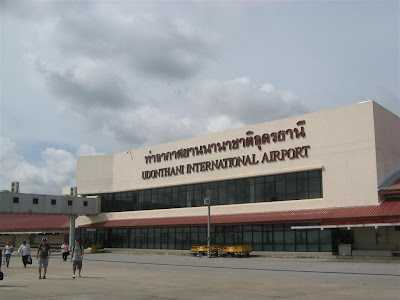

Thai Airways International, Nok Air and Thai AirAsia operate from this airport.

Udon Thani Airport is near northern border with Laos and is used as a transit point to Vientiane, Laos via Nong Khai Friendship bridge.
Udon Thani International Airport is approximately 280 miles (450 km) northeast of Bangkok and currently has domestic flights to Bangkok (Suvarnabhumi and Don Mueang) and Chiang Mai.


Thai Airways International, Nok Air and Thai AirAsia operate from this airport.

Udon Thani Airport is near northern border with Laos and is used as a transit point to Vientiane, Laos via Nong Khai Friendship bridge.
Isan Food
Isan food is mixture of the Lao and Thai cuisines, but it has taken something from both. Very typical is the use of sticky rice that accompanies almost every meal rather than plain rice.
Popular dishes include tammakhung, or in central Thailand, som tam (papaya salad), which is eaten at least once a day, larb (meat salad) and gai yang (grilled chicken).

Food market in Sangkha


Grasshoppers
Many people in Isan eat a wide variety of creatures, such as lizards, frogs and fried insects such as grasshoppers, crickets, silkworms and beetles.
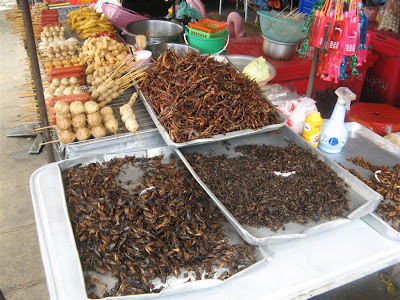

Popular dishes include tammakhung, or in central Thailand, som tam (papaya salad), which is eaten at least once a day, larb (meat salad) and gai yang (grilled chicken).

Food market in Sangkha


Grasshoppers
Many people in Isan eat a wide variety of creatures, such as lizards, frogs and fried insects such as grasshoppers, crickets, silkworms and beetles.


Building in the village
Earlier, construction materials were obtained from village´s natural environment, and they had to meet the requirements of the local conditions.
In Thailand, houses have been built of teak or similar oily wood, because termites, ants and other insects quickly destroy the soft wood. The roof was made of grass, as it is cool in the hot season; grass roofs are still used in many local workshops, such as forges.
The construction of a wooden house was one of the skills possessed by men of the village. In the past, all the son-in-laws had to build to his wife a house , it was proof of husband capacity. In the dry season, there was time for construction.
At the beginning of construction work, an offer was made to the phii of the compound, the supernatural guardian of the place, where the new family came to live, and the souls of ancestors were also invited to protect their parents in the new housing.
Nowadays, professional builders are needed: masons, carpenters and installers. Houses in villages, too, are equipped with opening windows, electricity and water pipes.
Before

Building


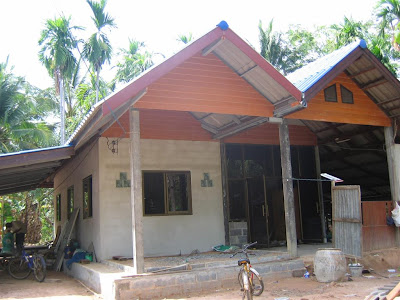
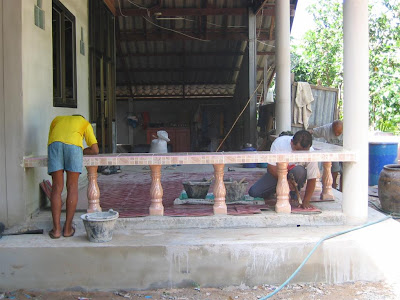

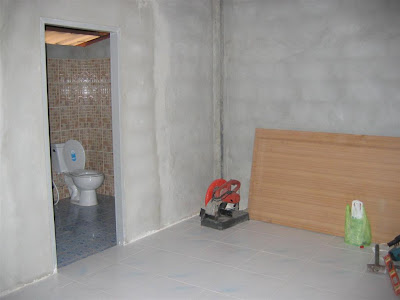
After.....coming later
In Thailand, houses have been built of teak or similar oily wood, because termites, ants and other insects quickly destroy the soft wood. The roof was made of grass, as it is cool in the hot season; grass roofs are still used in many local workshops, such as forges.
The construction of a wooden house was one of the skills possessed by men of the village. In the past, all the son-in-laws had to build to his wife a house , it was proof of husband capacity. In the dry season, there was time for construction.
At the beginning of construction work, an offer was made to the phii of the compound, the supernatural guardian of the place, where the new family came to live, and the souls of ancestors were also invited to protect their parents in the new housing.
Nowadays, professional builders are needed: masons, carpenters and installers. Houses in villages, too, are equipped with opening windows, electricity and water pipes.
Before

Building


After.....coming later
ThaiRadio

Stay connected - and get so much more - with the ThaiRadio Community Toolbar! FREE DOWNLOAD!
Listen to Live ThaiRadio Stations anywhere with the ThaiRadio Toolbar

You can add gadgets, your favorite radio stations etc. .
ฟังวิทยุ วิทยุ ฟังวิทยุผ่านเน็ต

Buses
The bus service in Thailand is very broad. You can get to most destinations by bus or by Song Taew (a city bus).

There are different "classes" on a bus in Thailand from the economy to VIP bus service. There are bus terminals in all cities on major routes in Thailand.
Surin bus terminal
You can find buses many different flavors. Local buses are very cheap and are suitable for travel between the near cities.

They are uncomfortable and not air conditioned. They also respond to the Thai people who are generally shorter than westerners. Falangs should not expect too much room for legs. If you travel further, then get an air-conditioned bus or VIP - they usually have comfortable seats, a toilet and drinks and snacks available. Thaibus timetables

There are different "classes" on a bus in Thailand from the economy to VIP bus service. There are bus terminals in all cities on major routes in Thailand.
Surin bus terminal

You can find buses many different flavors. Local buses are very cheap and are suitable for travel between the near cities.

They are uncomfortable and not air conditioned. They also respond to the Thai people who are generally shorter than westerners. Falangs should not expect too much room for legs. If you travel further, then get an air-conditioned bus or VIP - they usually have comfortable seats, a toilet and drinks and snacks available. Thaibus timetables
Farmer Life in Isan Village

Earlier hand harvesting was the only way in Isaan villages. Nowadays harvesting machines have become for great help. This machine is an old model and many people are still needed for manual work.

The big harvesting machine are already used in some villages and they have to be the thing of the future.
Many farmers do harvesting themselves with their families or friends and neighbours . After they have worked their fields, they go and help the neighbours to harvest.


House of Spirits
House of Spirits in Isan village

The view inside of house
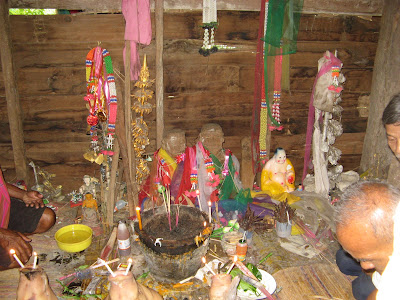

After the offer women asks good luck from the spirits


The view inside of house


After the offer women asks good luck from the spirits

Buffalo
Earlier buffalos were very important for thai farmers in their work. Nowadays machines make same work buffalos before.

Buffalo or ploughing machine?
Forty years ago, most villagers were against the ploughing machine and swore that the buffalo would never disappear from Thai villages. For 3000 years, it had been a part of rice farming, Thai culture, and it could not disappear unless Thai culture disappeared. However, events proved otherwise. The buffalo, as well as the zebu, have entirely disappeared from plains villages. The water buffalo is becoming an endangered species.
The buffalo was habituated to the existence that followed seasonal changes. In the dry season, buffalo were kept on the fields, grazing on rice stubble and grass growing on the dams. In the rainy season, when rice was growing, the buffalo had to be herded elsewhere, and it was work allocated to children. They had time for it, as there were no schools, and even later on, their school attendance was not considered to be important.
The buffalo is an undemanding animal, eating whatever nutrition was available in the environs of the village. In the dry season, the buffalo was satisfied with rice straw that would otherwise have been unused. Buffalo and zebu dung was used in seedbeds, fields and vegetable patches. Many of the informants pointed out that the buffalo fertilized the field even during ploughing, and in the water the dung was well mixed in the soil. Buffalo dung also harboured insects that were a local delicacy. By Matti Sarmela

Subscribe to:
Posts (Atom)